Every time you open a jar, carry a bag of groceries, or push up from a chair, you are either protecting your joints or stressing them. Most people never think about it. For the 27 million Americans living with osteoarthritis — and the millions more managing rheumatoid arthritis and other joint conditions — how you move through everyday life matters enormously.
Joint protection is not about doing less. It is about doing things differently. As a Doctor of Physical Therapy with 19 years of experience working with seniors and people with chronic conditions, I teach these techniques every day — and the results are consistently meaningful. Less pain, better function, more independence, and greater confidence in movement.
This guide covers the core principles of joint protection and translates them into practical, room-by-room strategies you can start using today.
What Is Joint Protection and Why Does It Work?
Joint protection is a self-management approach that maintains functional ability by changing how you perform everyday movements — reducing stress on affected joints while still allowing you to stay active and independent. First introduced in the 1960s for rheumatoid arthritis, its principles have since been extended to osteoarthritis and other joint conditions.
| 📊 Research Note: A randomized controlled trial found that participants in an eight-week self-management program focused on joint protection and physical activity showed significant improvements in physical functioning, self-efficacy for pain management, and self-management behaviors at six-month follow-up. Research confirms that joint protection activities performed correctly not only reduce pain but improve function — without risking harm to the joints. |
The 6 Core Principles of Joint Protection
These principles underlie every specific technique in this guide. Understanding them lets you apply joint protection creatively to any situation you encounter.
| ✅ Core Principle: Respect pain. Carry out activities only up to the point of discomfort — not beyond. Pain is information, not something to push through. If an activity causes sharp or persistent pain, stop and find a different approach. |
| ✅ Core Principle: Distribute load across larger joints. Use your shoulders, forearms, and palms instead of your fingers and wrists whenever possible. Larger joints can handle more stress than smaller ones. |
| ✅ Core Principle: Keep joints in their most stable, neutral positions. Avoid extreme ranges of motion and twisting movements. Joints are strongest in neutral alignment. |
| ✅ Core Principle: Avoid staying in any one position too long. Change positions every 20 to 30 minutes. Movement keeps joints lubricated and reduces stiffness. |
| ✅ Core Principle: Balance rest and activity throughout the day. Alternate heavy and light tasks. Spread demanding activities across multiple days rather than doing everything at once. |
| ✅ Core Principle: Plan activities that can be stopped if needed. Before starting a task, ask yourself: could I pause right now if my joints started hurting? If not, modify the task or have a stopping point built in. |
Room-by-Room Joint Protection Strategies
Kitchen: Protecting Hands and Wrists
The hand is the second most prevalent site of osteoarthritis, and the kitchen is full of tasks that stress hand and wrist joints when performed with default technique.
Opening jars: Place your palm flat on the lid and use your whole arm from the shoulder, rather than gripping and twisting with your fingers. A damp towel or rubber gripper under the jar prevents sliding. Electric jar openers eliminate the problem entirely.
Cutting and stirring: Hold knife handles like a dagger — with the handle resting against your knuckles rather than in a finger grip. Stir from the shoulder, not the wrist. Use ergonomic utensils with wide, padded handles.
Moving pots and pans: Never lift and carry when you can slide. Slide cookware across the stove or counter to the sink. Use a wheeled kitchen cart to move heavy items between the kitchen and table.
Carrying items: Support weight on your forearms and palms rather than gripping with fingers. Use two hands instead of one. Place frequently used items at waist height to eliminate overhead reaching and floor-level bending.
Meal prep: Sit while preparing food when possible. Use electric appliances — food processors, electric can openers, stand mixers — to reduce repetitive hand motions. Lightweight bamboo cookware is a good option for reducing carry weight.
Bathroom: Reducing Strain on Multiple Joints
Bathing and grooming: Use a long-handled sponge or bath brush to reach without twisting. Sit on a shower chair or bench to remove stress from hips, knees, and ankles. Choose pump dispensers for all liquid products rather than squeeze bottles.
Oral care: Use an electric toothbrush — less grip force, less repetitive motion. Apply toothpaste by pressing down on the dispenser rather than squeezing a tube.
Hair and grooming: Rest elbows on the counter while styling hair and applying makeup to reduce shoulder strain. Use a lightweight blow dryer held with both hands when possible.
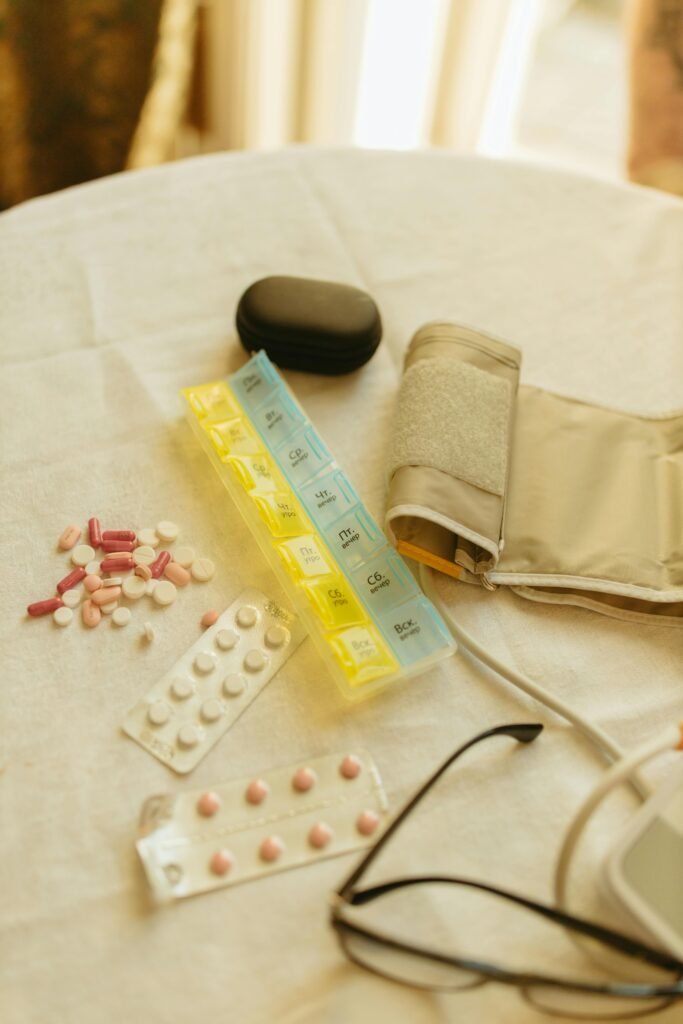
Medications: Ask your pharmacist for easy-open caps. Use a pill organizer to avoid repeatedly opening multiple small bottles. Store medications at waist level.
Bedroom and Closet: Easier Dressing
Clothing choices: Choose elastic waistbands, Velcro closures, and large buttons over tight waistbands, small buttons, and back zippers. Front-opening garments are significantly easier to manage than pullovers.
Dressing technique: Always sit down to dress — it is safer and less fatiguing. Dress your weaker or more painful side first; undress it last.
Dressing aids: Sock aids, long-handled shoehorns, button hooks, and zipper pulls reduce bending and fine motor demands significantly. These are inexpensive and widely available.
Footwear: Choose Velcro closures or elastic laces over traditional laces. A small heel (about one inch) is often most comfortable for joint alignment. Use a long-handled shoehorn to eliminate bending.
General Household Tasks
Cleaning: Use long-handled mops, dusters, and dustpans to avoid bending and overhead reaching. Break cleaning sessions into shorter segments spread across multiple days. Use lightweight vacuums with ergonomic handles.
Lifting and carrying: Never lift items by their handles with just your fingers. Support weight on your palm and forearm. Use a backpack rather than a shoulder bag to distribute weight evenly. Use rolling carts and baskets whenever possible.
Doors and locks: Use your whole hand or forearm to push doors open. Install lever-style door handles to replace round knobs — much less grip force required. Use a key turner or smart lock.
Reading and computer use: Use a book stand or tablet stand rather than holding reading materials. Position your computer screen at eye level and keyboard at elbow height. Take breaks every 20 to 30 minutes to change position and stretch.
Yard and Garden
Gardening: Use raised garden beds or container gardens to eliminate excessive bending and kneeling. Choose long-handled tools. Use a wheeled garden cart for moving soil, tools, and harvested plants. Wear padded garden gloves. Limit gardening sessions to 20 to 30 minutes with rest breaks.
Yard maintenance: Choose electric or battery-powered tools over manual ones. Hire help for heavy tasks like moving large bags of mulch or soil.
Assistive Devices Worth Knowing About
The right tools are not a sign of weakness — they are a practical strategy for staying independent and reducing pain. An occupational therapist can help identify which devices would be most beneficial for your specific situation.
Kitchen
- Electric jar openers and can openers
- Lightweight pots, pans, and bamboo cookware
- Utensils with built-up, padded handles
- Wheeled kitchen carts
- Non-slip cutting boards with ergonomic edges
Personal Care
- Long-handled sponges and brushes
- Electric toothbrushes and razors
- Pump dispensers for all liquid products
- Shower chairs or benches
- Grab bars near toilet and shower
- Sock aids and dressing sticks
General Use
- Reachers and grabbers
- Key turners and enlarged key holders
- Lever-style door handles
- Ergonomic scissors and writing implements
- Book and tablet stands
- Rolling carts and baskets
Building Your Joint Protection Habits
Start with what hurts most. Choose one or two activities that cause you the most joint pain and focus there first. Once those changes feel natural, add more.
Track what helps. Keep brief notes on which techniques reduce pain and which don’t. This helps you refine your approach over time.
Involve your household. Teach family members the basics — like not over-tightening jar lids — so they’re supporting your efforts rather than accidentally making things harder.
Be patient with habit change. You will revert to old patterns sometimes. Notice it without self-criticism and return to the joint-protective approach.
Consider professional guidance. An occupational therapist or physical therapist can provide a personalized assessment, teach techniques tailored to your specific joints and activities, and recommend adaptive equipment. Many insurance plans including Medicare cover these services for arthritis.