
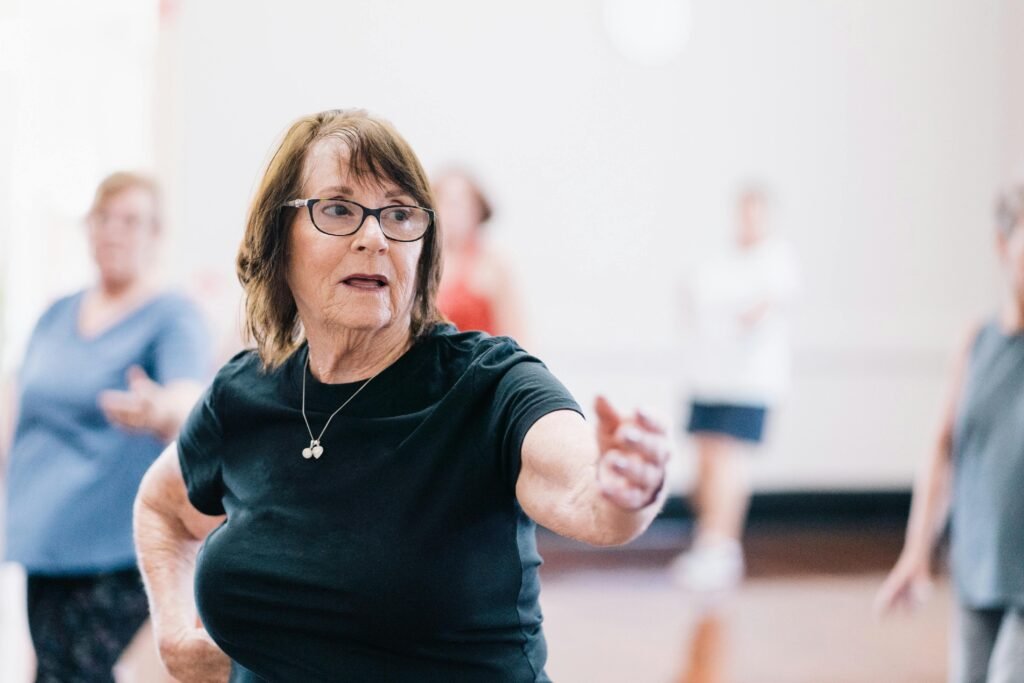
I’ve seen it happen more times than I can count. An older adult decides they’re done with exercise — maybe after a hip replacement, a bad fall, or years of arthritis pain convincing them that movement and discomfort are unavoidable partners. And then they discover chair-based exercise, and something shifts.
The 82-year-old who thought her exercising days were behind her. The man with severe arthritis who believed pain meant he couldn’t move. The nursing home resident who regained the strength to transfer independently after months of seated work. These aren’t outliers — they’re what I see regularly when older adults are introduced to chair exercises as a legitimate, research-supported form of physical activity.
Chair-based exercise has spent too long being dismissed as “exercise lite” — a last resort for people who can’t do “real” exercise. That view is both outdated and harmful. Research clearly shows that seated exercise programs improve upper and lower body strength, enhance physical fitness across multiple domains, support mental well-being, and reduce fall risk. The chair isn’t a limitation. Used correctly, it’s a tool.
This guide covers what chair-based exercise actually is, who benefits from it, what the science shows, and how to start — safely and effectively — today.
What Is Chair-Based Exercise?
You might think the definition is obvious — exercise done in a chair — but the field has actually lacked a clear, standardized definition for years, which has contributed to inconsistent practices and underestimation of its value.
A multidisciplinary expert panel conducted a comprehensive consensus study to establish what chair-based exercise (CBE) should be. After four rounds of consultation with 16 experts, they agreed on five core principles:
- CBE is primarily a seated exercise program, though it may include supported standing transitions.
- The chair’s purpose is to promote stability in both sitting and standing positions, providing safety and confidence for those with balance or mobility concerns.
- CBE should be viewed as part of a continuum, not a permanent endpoint. Progression to more challenging activities is encouraged when appropriate.
- CBE should be used flexibly, adapting to a person’s changing needs and capabilities over time.
- Where possible, CBE should serve as a starting point toward standing programs — not a ceiling, but a foundation.
This framing matters. Chair-based exercise is not a concession to inability. It is an intentional, therapeutic approach with a clear purpose: to provide a safe, accessible entry point for physical activity while actively encouraging improvement and progression.
Who Benefits from Chair Exercises?
Chair-based exercise is particularly valuable for:
- Adults age 65 and older experiencing age-related changes in strength, balance, or mobility
- People who use walkers, canes, or wheelchairs
- Those managing chronic conditions such as arthritis, COPD, heart disease, or osteoporosis that make standing exercise difficult
- Anyone recovering from surgery or injury who needs a gradual, safe return to activity
- Individuals with significant balance impairment or fear of falling that prevents them from exercising while standing
- Nursing home and assisted living residents with multiple health conditions or mobility limitations
- Anyone for whom balance or mobility is a concern, regardless of specific diagnosis
Research on chair-based exercise spans a broad population — community-dwelling older adults, nursing home residents, people with Parkinson’s disease or dementia, and pre-frail adults at risk of further decline. The flexibility of the format makes it adaptable to nearly any functional level.
| 💡 PT Tip: Even if you can stand and walk comfortably, chair exercises are a valuable tool for days when you’re fatigued, recovering from illness, or want to focus on specific movements without the added balance demand of standing. |
What the Research Shows
Strength Gains — Upper and Lower Body
A 2021 systematic review and meta-analysis synthesized evidence from 25 studies involving 1,388 participants age 50 and older. The results were clear: chair-based exercise programs produce meaningful improvements in both upper and lower extremity strength.
| 📊 What the Research Shows: Handgrip strength improved by an average of 2.10 kg. The 30-second arm curl test improved by 2.82 repetitions. The 30-second chair stand test — a direct measure of the leg strength needed for rising from a chair, toilet, or bed — improved by 2.25 repetitions. |
Those numbers may seem modest, but their functional significance is real. Being able to complete even a few more chair stands can mean the difference between managing independently and needing assistance with daily tasks.
Fitness Across Multiple Domains
A study of chair-based home exercises for older adults with balance disorders found significant improvements not just in strength, but also in cardiovascular endurance (two-minute step test), flexibility (chair sit-and-reach and back stretch), and functional mobility (eight-foot up-and-go test). Well-designed chair exercise programs don’t just target one fitness component — they address the full picture.
Mental Well-Being and Quality of Life
Beyond the physical, chair-based exercise consistently shows positive effects on mood, confidence, and social connection. Research on pre-frail older women found improvements in both functional fitness and mental well-being. Exercise instructors consistently report observing better mood, improved cognition, and stronger social bonds among participants in group chair exercise programs.
One study concluded that chair-based exercise stops the decrease in functional fitness even in very aged persons — and framed this as a profoundly positive outcome because the abilities tested are directly connected to daily life. Maintaining function means maintaining independence, dignity, and quality of life.
Safety
The systematic review noted that chair-based exercises are effective and should be promoted as simple, easily implemented activities for maintaining and developing strength in older adults — with very few adverse events reported across studies. For those at high fall risk or with multiple health conditions, this safety profile is not a minor detail. It’s often what makes exercise possible at all.
What Consistent Chair Exercise Can Do for You
Maintain independence. Strengthening the muscles used for transferring from bed to chair, getting on and off the toilet, and moving around your home preserves the ability to live independently.
Reduce fall risk. Improved leg strength and functional mobility reduce the likelihood of falling. Even if you do lose your balance, stronger muscles help you recover faster or fall more safely.
Manage chronic conditions. Regular movement helps control blood sugar in diabetes, reduces blood pressure, manages arthritis pain, and improves breathing capacity in COPD.
Combat social isolation. Group chair exercise classes provide community and connection — both of which research links to better mental health and longer life.
Build confidence. Completing exercises and seeing measurable improvement restores belief in your physical capabilities. That confidence reduces the fear of movement that keeps many people trapped in inactivity.
Create a sustainable starting point. For those who have been inactive for months or years, chair exercise provides a non-intimidating entry point. As strength and confidence build, more challenging activities become possible.
What Makes a Chair Exercise Program Effective
Structure
Effective programs follow a consistent structure: a warm-up of 5 to 10 minutes of gentle movement and range-of-motion work; a main session of 20 to 40 minutes addressing multiple muscle groups and fitness components; and a cool-down of 5 to 10 minutes of stretching and relaxation. Studies showing the strongest outcomes involve programs lasting at least 8 to 12 weeks, meeting 2 to 3 times per week, with sessions of 30 to 60 minutes.
Progressive Overload
Like any effective exercise program, chair-based exercise needs to get progressively harder over time. That progression might look like adding repetitions, incorporating resistance bands or light weights, increasing range of motion, reducing hand support for balance challenges, or transitioning from seated to supported standing exercises when appropriate. The goal is adaptation, not maintenance of the status quo.
Variety
Good programs address all major muscle groups — legs, arms, back, chest, and core — and include a mix of strength work, flexibility, cardiovascular conditioning through seated aerobics or marching, and functional movements that mirror daily activities. Variety maintains engagement and ensures well-rounded fitness development.
Qualified Instruction
Chair-based exercise is generally safe, but proper instruction makes a meaningful difference. A qualified professional understands how to progress exercises appropriately for older adults, recognizes warning signs that warrant stopping, modifies movements for individual limitations, and — importantly — brings a positive, encouraging attitude to seated programs. Research notes that instructor attitude directly influences participant outcomes.
How to Get Started with Chair Exercises
Choose the Right Chair
Use a sturdy, stable chair that won’t tip, wobble, or slide. Avoid desk chairs with wheels. A chair without armrests gives you more freedom of movement and reduces the risk of bumping yourself during arm exercises. The seat height should allow your feet to rest flat on the floor when seated.
Start Simply
If you’re new to exercise or have been inactive for a while, begin with these gentle movements and work up to 10 to 15 repetitions of each:
- Seated marches — lift alternating knees at a comfortable pace
- Arm circles and shoulder rolls — loosen up the upper body
- Ankle circles and seated leg extensions — keep the lower legs moving
- Seated torso twists — gentle core engagement
- Reaching movements in multiple directions — build range of motion
Even 10 to 15 minutes of gentle movement several times a week provides measurable benefits. You don’t need to start with hour-long sessions.
Progress Gradually
Add time, repetitions, or resistance slowly over weeks — not days. If muscle soreness lasts more than 48 hours, you’ve progressed too quickly. Back off slightly and build more gradually. Some mild discomfort during or immediately after exercise is normal. Sharp pain, dizziness, or unusual shortness of breath means stop and check in with your doctor.
Explore Classes, Videos, and Books
Many community centers, senior centers, and YMCAs offer group chair exercise classes — which add the benefits of social connection and live instruction. Online videos are another accessible option; look for those created by physical therapists, occupational therapists, or certified professionals specializing in older adults.
Dr. Abha’s book Chair Yoga for Seniors contains 100 exercises designed specifically for seated practice — ranging from gentle stretches to more challenging strength movements — providing a comprehensive home practice guide at any level.
| 💡 PT Tip: Chair-based exercise works best as part of a broader healthy aging approach that also includes walking, appropriate standing activities when possible, good nutrition, adequate sleep, and active management of chronic health conditions. |
Common Misconceptions — Addressed
“Real exercise has to be done standing.” Exercise is any movement that challenges your body beyond its resting state. Seated exercise can provide significant cardiovascular, strength, and flexibility benefits. The research is clear on this.
“I’ll be stuck doing chair exercises forever.” Not necessarily. Many people use chair-based exercise as a starting point and progress to standing activities as their strength and confidence grow. It’s a foundation, not a ceiling.
“I can stand, so chair exercises aren’t for me.” Even fully mobile adults benefit from chair exercises on fatigued days, during illness recovery, or when they want to target specific movements without the added balance demand. They’re also easy to do while watching TV.
“Chair exercises look weak.” Strength is about working at your edge — not about the equipment you use. Someone doing chair squats at the limit of their current ability is working just as hard as someone lifting heavy weights at theirs.
Movement Is Medicine — Seated or Standing
For millions of older adults, chair-based exercise is what makes physical activity accessible, safe, and sustainable. The evidence is clear: it improves strength, enhances functional capacity, supports mental well-being, and helps people maintain independence. It’s not a lesser alternative to standing exercise. It’s a valuable, flexible tool in the comprehensive approach to healthy aging.
Whether you’re 65 or 95, whether you use a walker or have perfect balance, whether you’re recovering from surgery or managing multiple conditions — there is a place for chair-based exercise in your life. Every repetition counts. Every movement matters. And none of it has to look like anyone else’s workout to be real, valuable, and worth doing.