
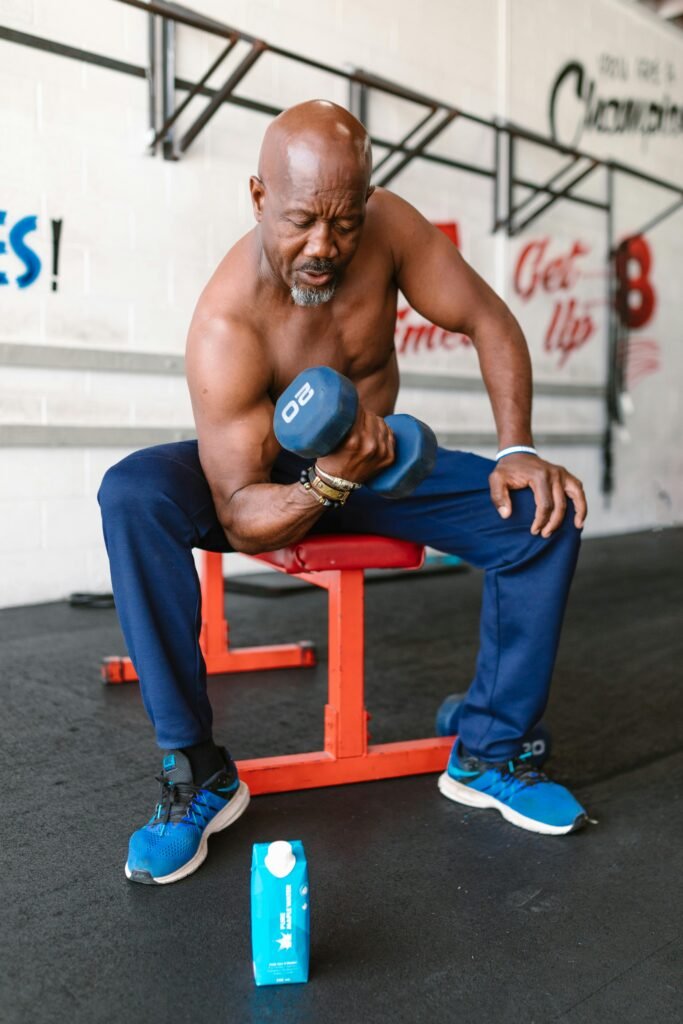
There’s a moment I witness regularly in my work as a Doctor of Physical Therapy: an older adult who assumed declining strength was simply part of getting older discovers — sometimes within just a few weeks — that they can get stronger. Noticeably, meaningfully stronger.
The science supports what I see in practice. Resistance training can slow and in many cases reverse the muscle fiber changes associated with aging. This isn’t about building a beach body. It’s about being able to carry your groceries, get up off the floor, climb stairs without gripping the railing for dear life, and stay in your own home as long as you choose.
Whether you’re 65 or 95, sedentary or moderately active, this guide will walk you through how to start strength training safely, what the research actually says about training intensity, and exactly which exercises to begin with. Let’s get into it.
Why Strength Training Matters as You Age
About 30% of adults over age 70 have measurable difficulty with basic tasks like walking, rising from a chair, or climbing stairs. That’s not an inevitable consequence of aging — it’s largely the result of sarcopenia, the progressive loss of muscle mass and strength that begins in our 30s and accelerates after 60.
Without any intervention, adults lose approximately 3% to 8% of muscle mass per decade after age 30, with the rate picking up speed after 60. Maximal strength typically declines about 1% per year from the fifth decade onward. The muscle fibers hit hardest are the fast-twitch fibers — the ones responsible for catching yourself when you trip, lifting heavier objects, and performing strength-based tasks like yard work or carrying groceries.
The ripple effects go beyond the muscles themselves. Muscle tissue helps regulate blood sugar by acting as the body’s primary site for glucose disposal. As muscle mass declines, the body becomes less efficient at managing blood sugar — increasing the risk of insulin resistance and type 2 diabetes. Bone density follows a similar pattern, with muscle loss contributing to the increased fracture risk seen in older adults.
Here’s the encouraging part: research has shown that strength training can counter these effects at virtually any age. Studies have documented meaningful strength gains in adults in their 70s, 80s, and 90s — including frail nursing home residents. A 70-year-old who commits to a consistent resistance training program can restore maximal muscle strength to levels comparable to much younger individuals within just a few weeks of training.
| 💡 PT Tip: The most untrained individuals make the largest gains when they begin strength training. If you’ve been inactive, you actually have the most to gain — physiologically and functionally — from starting now. |
The Benefits of Strength Training for Older Adults
The benefits of regular resistance training extend well beyond the gym:
Physical Health
- Reverses or slows sarcopenia — rebuilding lost muscle mass and strength
- Preserves bone density and reduces osteoporosis risk
- Significantly reduces fall risk by improving balance and coordination
- Improves blood sugar regulation and lowers risk of type 2 diabetes
- Reduces symptoms of arthritis, heart disease, and other chronic conditions
- Improves sleep quality
Cognitive & Emotional Health
- Slows cognitive decline in adults with mild cognitive impairment
- Reduces symptoms of depression and anxiety
- Increases self-confidence and sense of independence
- Improves overall psychological well-being
Functional Independence
- Makes daily tasks easier — climbing stairs, carrying items, standing from a seated position
- Reduces fear of falling and increases confidence in movement
- Extends the period of independent living
- Improves healthy life expectancy
Research supported by the National Institute on Aging has found that the most effective strategy for improving physical function and avoiding disability combines walking with resistance training. Even low-intensity programs produce substantial benefits — and functional resistance training, which targets the movement patterns used in everyday life, may be especially powerful for maintaining independence.
Getting Started: Core Principles for Safe Strength Training
1. Talk to Your Healthcare Provider First
Before beginning any strength training program, have a conversation with your doctor or physical therapist — especially if you have a history of heart disease, high blood pressure, joint problems, diabetes, or osteoporosis. Your provider can flag any modifications you’ll need and may recommend working with a physical therapist to develop a program tailored to your specific health profile.
2. Start Where You Are, Not Where You Think You Should Be
Don’t compare yourself to others or to a younger version of yourself. Your starting point is your starting point — and as noted above, the biggest gains go to those who are starting from the bottom. There is no baseline too low to begin.
3. Prioritize Form Over Weight
Correct technique is more important than the amount of resistance you’re using, especially in the beginning. Poor form reduces effectiveness and raises injury risk. Take the time to learn proper movement patterns before adding significant weight.
4. Progress Gradually and Stay Consistent
Consistency matters more than intensity when you’re building a foundation. Research shows that meaningful health benefits can be achieved through a wide range of training approaches — from highly supervised clinical programs to simple, minimally-guided home routines. The key is showing up regularly and progressing over time.
5. Give Your Muscles Time to Recover
Two to three sessions per week with at least one rest day between sessions is the well-researched sweet spot for older adults. This schedule is sufficient to produce significant strength gains while giving your body the recovery time it needs.
Choosing Your Strength Training Approach
The best method is the one that fits your current fitness level, access to equipment, and personal preferences. Here are your main options:
Gym Machines — Best for Beginners
Weight machines guide your movement pattern, which reduces the balance and coordination demands on a beginner. They’re easier to adjust and generally safer for those with balance concerns. Most gyms offer orientation sessions. Start with machines targeting major muscle groups — leg press, chest press, seated row, lat pulldown — using a weight that allows 10 to 15 reps with good form.
Free Weights (Dumbbells) — Best for Versatility
Dumbbells can be used at home, are relatively inexpensive, and build stabilizer muscles alongside primary movers. Start light — 2 to 5 pounds — and focus on controlled movements. Key exercises include bicep curls, overhead presses, lateral raises, and weighted squats. Progress once 15 reps feel easy.
Resistance Bands — Best for Home or Travel
Bands are affordable, portable, and provide variable resistance throughout the movement. They’re gentler on joints and easy to scale by changing tension or grip position. A set with several resistance levels gives you room to progress. Bands are especially effective for upper body work and can be anchored to a door for additional variety.
Body Weight Training — Best for Zero Equipment
No gym, no equipment, no cost — body weight training is accessible to everyone. Chair squats (sit-to-stand), wall push-ups, heel raises, and step-ups build meaningful strength using movement patterns directly relevant to daily life. Every exercise can be scaled to any fitness level.
Functional Resistance Training — Best for Daily Life Carryover
Functional training targets the specific movement patterns used in everyday activities — lifting from the floor, reaching overhead, transitioning from sitting to standing. Research suggests this approach may improve movement efficiency and reduce fall risk more effectively than traditional resistance training alone. Working with a physical therapist to learn these patterns is ideal.
A Beginner Full-Body Strength Program
Perform this routine 2 to 3 times per week, with at least one rest day between sessions. Begin with 1 set of each exercise and work up to 2 sets as the exercises become easier.
Warm-Up (5 Minutes)
- Gentle walking in place or around your home
- Arm circles and shoulder rolls
- Ankle circles and gentle leg swings
- Light stretching of major muscle groups
The Exercises — 1 to 2 Sets of 10 to 15 Repetitions Each
- Chair Squats (Legs): Stand in front of a sturdy chair. Lower yourself to just touch the seat, then stand back up. Keep your weight in your heels and your chest lifted.
- Wall Push-Ups (Chest & Arms): Stand arm’s length from a wall with hands at shoulder height. Bend elbows to bring your chest toward the wall, then push back. Keep your body in a straight line.
- Seated Row with Band (Back): Sit in a chair with a resistance band looped around your feet. Pull handles toward your waist while squeezing your shoulder blades together. Release slowly.
- Bicep Curls (Arms): Hold light dumbbells or water bottles with elbows at your sides. Curl hands toward shoulders, then lower slowly.
- Overhead Press (Shoulders): Hold weights at shoulder height. Press overhead until arms are extended, then lower slowly.
- Heel Raises (Calves): Stand behind a chair for balance. Rise up onto your toes, hold briefly, then lower slowly.
- Side Leg Raises (Hips): Stand behind a chair for support. Lift one leg out to the side with your toe pointing forward, then lower slowly. Alternate sides.
Cool-Down (5 Minutes)
- Gentle walking
- Static stretching of all major muscle groups
- Deep breathing
| 💡 PT Tip: When 15 repetitions feel easy and your form is solid, increase resistance by 5% to 10%. This principle — called progressive overload — is what drives continued strength gains over time. |
Training Intensity: What the Research Actually Shows
Many older adults assume they should stick to very light weights to stay safe. The research tells a more nuanced story. High-intensity resistance training — above 75% of maximal strength — produces greater strength increases than low-to-moderate intensity training, according to a meta-analysis of 29 studies involving more than 1,300 adults over 65.
That doesn’t mean you should start heavy. It means that as your form improves and your foundation builds, progressively increasing resistance will produce better results than staying with light weights indefinitely. The goal is to keep challenging your muscles — gradually, consistently, and safely.
For practical purposes: if you can comfortably complete 15 reps with good form, it’s time to increase resistance. That’s your signal to move forward.
Safety: What’s Normal and When to Stop
Strength training is remarkably safe when done correctly. That said, it’s important to know the difference between normal training sensations and warning signs.
Normal Sensations
- Mild muscle fatigue during exercise
- Slight muscle soreness 24 to 48 hours after exercise — this is a sign your muscles are adapting
- Feeling energized after a workout
- Gradual improvement in how exercises feel over weeks
| ⚠️ Stop and consult your healthcare provider if you experience: chest pain or pressure, severe shortness of breath, dizziness or lightheadedness, irregular heartbeat, severe joint pain, or any sharp acute pain. These require medical evaluation before continuing. |
General Safety Tips
- Breathe continuously — never hold your breath during an exercise
- Move through the full range of motion without bouncing or jerking
- If balance is a concern, exercise near a wall or sturdy furniture
- Stay well hydrated before, during, and after exercise
- Wear supportive, non-slip footwear
- Train in a clear, well-lit space free of tripping hazards
Fueling Your Muscles: Nutrition Basics
Exercise is only half the equation. Your muscles need adequate protein to recover and grow stronger. Research suggests older adults aim for approximately 1.2 grams of protein per kilogram of body weight per day. For a 150-pound person, that’s roughly 82 to 85 grams of protein daily.
Good protein sources include lean meats, fish, eggs, dairy products, legumes, nuts, and protein supplements if needed. Spreading protein intake throughout the day — rather than concentrating it in one meal — allows your muscles to use it more effectively for repair and growth.
Tracking Your Progress
Keep a simple training log — exercise, sets, reps, and resistance used. This makes it easy to see progress and know when it’s time to increase the challenge.
Progress isn’t always measured in pounds lifted. Other meaningful signs include exercises feeling easier, better balance and posture, easier stair climbing and grocery carrying, increased energy throughout the day, improved sleep, and better mood and confidence. All of these count.
Common Concerns — Answered
“I’m too old to start.” Studies have documented successful strength training in people in their 80s and 90s. Age is not a barrier.
“I don’t have time.” A full-body workout takes 20 to 30 minutes, two to three times per week. That’s less time than a single TV episode.
“I’m afraid of getting hurt.” Properly designed strength training is extremely safe. Not training carries far greater long-term risk — increased falls, fractures, and loss of independence.
“I’m too out of shape.” The most deconditioned individuals make the largest gains. Your current fitness level is your starting point, not a disqualifier.
“I don’t know what to do.” That’s exactly what this guide — and a physical therapist — is for. Even two or three sessions with a professional can provide personalized instruction that sets you up for long-term success.
Your Stronger Future Starts Now
Strength training isn’t a short-term fix. It’s a long-term investment in your independence, your health, and your quality of life. Research shows that stronger older adults live longer and remain functional longer than those with low muscle strength. The benefits build month by month, year by year.
You don’t need to become a gym regular overnight. You need to start — with chair squats in your living room, a couple of resistance bands, or a guided session with a physical therapist. Your muscles don’t know your age. They respond to stimulus. Give them a consistent, progressive stimulus, and they will respond.